
영어 학습 여정에서 규칙적인 연습이 중요한 이유는 무엇인가요?
읽기, 쓰기, 듣기, 말하기 연습을 통해 영어를 배우는 데 시간과 노력을 투자하는 것은 언어 능력을 향상시키고 자신감 있는 커뮤니케이터가 되기 위해 필수적입니다.
게시물이 마음에 드시나요? 지금 공유하세요!
Parenthetical phrases make your writing richer, clearer, and more engaging—but they can be tricky for English learners. This guide explains how to use parentheses, dashes, and commas in simple steps, with examples and easy tips so you can write like a pro.
Have you ever been reading and noticed a little “extra” bit of information tucked inside a sentence? That’s a parenthetical phrase—like a whispered secret in your writing.
A parenthetical phrase adds extra details, clarifies meaning, or gives side information without changing the main idea. If you remove it, the sentence still makes sense.
Example:
Parenthetical phrases are often used to:
They can appear:
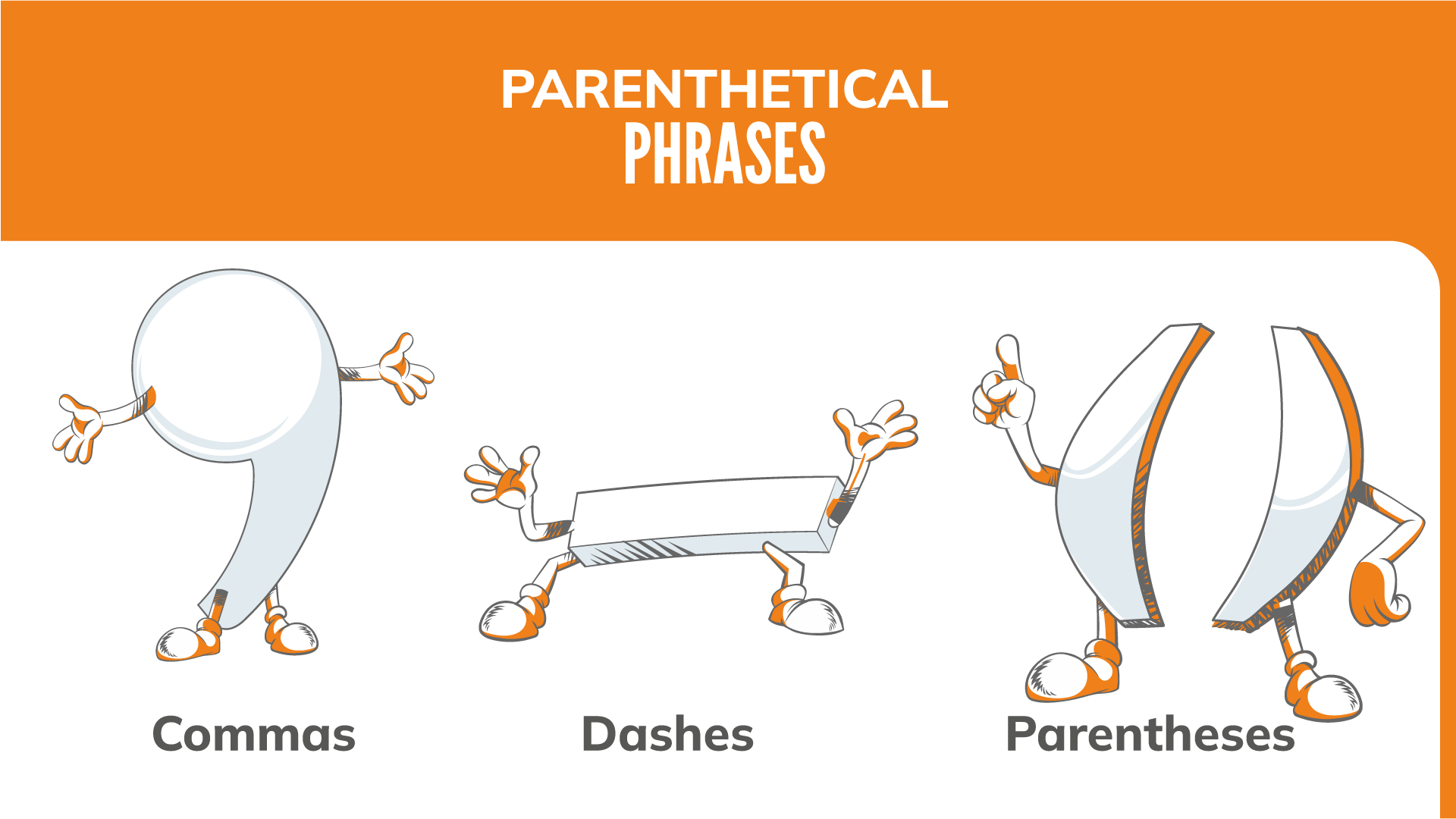
In English, we can use parentheses, dashes, or commas. Each has its own “personality.” Let’s meet them.
Personality: Quiet, polite, and discreet. Parentheses are like little bubbles that hide your extra thoughts.
Example:
Here, “a great weekend activity for students taking English classes in London” is bonus information. It’s not essential, but it’s interesting.
Tips for using parentheses:
Personality: Dramatic and attention-grabbing. Dashes shout, “Hey, this is important or surprising!” They work well for emphasis.
The city—especially for students enrolled in language classes London—comes alive at night.
Here, “especially for students enrolled in language classes London” adds emphasis, making it feel more vivid.
Tips for using dashes:
Personality: Friendly and flexible. Commas are the most common way to add parenthetical phrases, especially in everyday writing.
Sarah, who used to browse ‘learn English classes near me’, is visiting London next week.
The commas show the extra info “who used to browse ‘learn English classes near me’ without breaking the flow.
Tips for using commas:
A parenthetical phrase is optional. If removing it changes the sentence’s meaning completely, it’s not a parenthetical phrase.
Example:
So, parenthetical = nice to have, not need to have.
One tricky part for learners is deciding where to put the parenthetical phrase.
The easiest rule is:
Example:
You should also think about flow—your sentence should be smooth before and after the phrase. Try reading it aloud without the parenthetical part. If it feels strange, you might need to change the order.
She loves travelling, especially Paris (her favourite city,—and London). ✔ Use either parentheses, dashes, or commas—not a mix.
Too many parenthetical phrases can make your sentence messy. Keep them meaningful.
If your sentence ends with a parenthetical phrase, put the full stop outside the brackets unless the whole sentence is inside.
Example:
We went to Hyde Park (and got caught in the rain).
(It was one of the best days in London.)
Choose the correct punctuation for each sentence:
Check out the correct answers here!
Think of parentheses, dashes, and commas like three different camera lenses. Each one gives a different focus and feeling to your writing. Choose the one that matches your tone—formal, casual, or creative.
Ready to take your English to the next level? Enquire today about our courses at ES London—the friendly English language institute where learning is clear, fun, and practical.
읽은 내용이 마음에 드셨나요? ES의 모든 소식에 대한 최신 정보를 알려드리고 싶습니다. 다양한 코스, 런던에 대한 흥미로운 사실, 뉴스, 업데이트, 놀라운 성공 사례 등을 확인해 보세요.

읽기, 쓰기, 듣기, 말하기 연습을 통해 영어를 배우는 데 시간과 노력을 투자하는 것은 언어 능력을 향상시키고 자신감 있는 커뮤니케이터가 되기 위해 필수적입니다.
IELTS 시험을 준비 중이신가요? 올바른 기술과 전략을 알면 더 높은 IELTS 점수를 얻는 데 도움이 될 수 있습니다. 다음은 피해야 할 몇 가지 일반적인 실수입니다.

영어 원어민들이 흔히 사용하는 문구와 답변이 많이 있습니다. 다음은 원어민과 유창하게 대화하는 데 도움이 되는 가장 자주 사용되는 영어 문구입니다.

저희는 그렇게 말하지 않습니다,
ES Education은 모든 학생들에게 영어 학습을 기억에 남는 즐거운 경험으로 만들어 드립니다. 저희는 가족 같은 학교 분위기에 자부심을 가지고 있습니다. 다양한 커뮤니티에서 우리와 함께 런던을 배우고 발견함으로써 학교는 제2의 집이 될 것입니다!