Parenthetical phrases make your writing richer, clearer, and more engaging—but they can be tricky for English learners. This guide explains how to use parentheses, dashes, and commas in simple steps, with examples and easy tips so you can write like a pro.
Let’s Talk About Parenthetical Phrases
Have you ever been reading and noticed a little “extra” bit of information tucked inside a sentence? That’s a parenthetical phrase—like a whispered secret in your writing.
A parenthetical phrase adds extra details, clarifies meaning, or gives side information without changing the main idea. If you remove it, the sentence still makes sense.
Example:
My teacher, who taught at language schools in central London, loves tea. If we remove “who taught at language schools in central London”, the main sentence “My teacher loves tea” is still complete.
Parenthetical phrases are often used to:
Give background information.
Add personal comments.
Clarify meaning.
Make your writing more interesting.
They can appear:
In the middle of a sentence: The River Thames, which flows through London, is famous worldwide.
At the start of a sentence: As you may know, English courses in London are popular with students from all over the world.
At the end of a sentence: I’m going to Oxford Street tomorrow, if the weather is nice.
Three Ways to Show Parenthetical Phrases
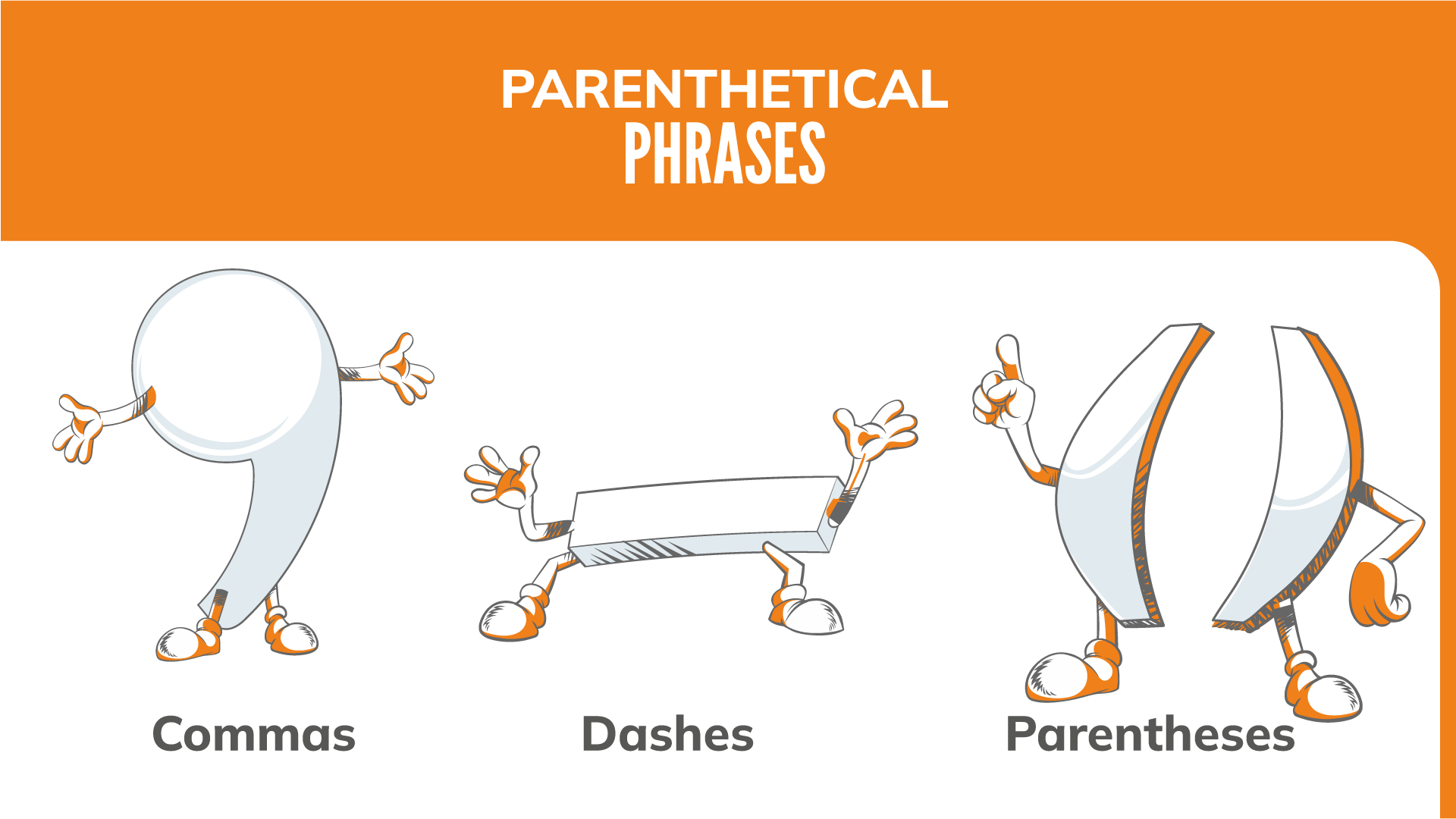
In English, we can use parentheses, dashes, or commas. Each has its own “personality.” Let’s meet them.
A. Parentheses (…)
Personality: Quiet, polite, and discreet. Parentheses are like little bubbles that hide your extra thoughts.
Example:
We visited the British Museum (a great weekend activity for students taking English classes in London) during our trip.
Here, “a great weekend activity for students taking English classes in London” is bonus information. It’s not essential, but it’s interesting.
Tips for using parentheses:
Don’t use them for main points—only for side notes.
Make sure the sentence is still correct without the parentheses.
Keep them short for easy reading.
Avoid using them too often—they can make your writing look “too busy.”
B. Dashes —
Personality: Dramatic and attention-grabbing. Dashes shout, “Hey, this is important or surprising!” They work well for emphasis.
The commas show the extra info “who used to browse ‘learn English classes near me’ without breaking the flow.
Tips for using commas:
Use them for non-essential information.
Make sure your sentence still works without the middle part.
Avoid “comma overload”—too many can be confusing.
Remember that commas for parenthetical phrases come in pairs—one before and one after.
The Golden Rule: It’s Optional
A parenthetical phrase is optional. If removing it changes the sentence’s meaning completely, it’s not a parenthetical phrase.
Example:
Incorrect: The girl who won the race is my sister. Here, “who won the race” is essential information—it’s not extra. If you remove it, the meaning changes.
So, parenthetical = nice to have, not need to have.
More About Placement and Flow
One tricky part for learners is deciding where to put the parenthetical phrase.
The easiest rule is:
Place it next to the word or idea it is giving more information about.
Example:
Correct: Trafalgar Square, one of London’s busiest spots for tourists and English language institute students, is always lively.
Incorrect: Trafalgar Square is popular, one of London’s busiest spots, with tourists. (The phrase feels “lost” here.)
You should also think about flow—your sentence should be smooth before and after the phrase. Try reading it aloud without the parenthetical part. If it feels strange, you might need to change the order.
避けるべき一般的な間違い
Mistake 1: Mixing punctuation
She loves travelling, especially Paris (her favourite city,—and London). ✔ Use either parentheses, dashes, or commas—not a mix.
Mistake 2: Adding unnecessary information
Too many parenthetical phrases can make your sentence messy. Keep them meaningful.
Mistake 3: Forgetting closing punctuation
If your sentence ends with a parenthetical phrase, put the full stop outside the brackets unless the whole sentence is inside.
Example:
We went to Hyde Park (and got caught in the rain).
(It was one of the best days in London.)
Quick Practice Quiz
Choose the correct punctuation for each sentence:
London ____ especially during Christmas ____ looks magical at night. a) ( … ) b) — … — c) , … ,
We visited Camden Market ____ which is famous for street food ____ last weekend. a) , … , b) — … — c) ( … )
The National Gallery (a favourite place for English class London students) has beautiful art from all over the world. a) Parentheses b) Dashes c) Commas
Check out the correct answers here!
Answers: 1-b 2-a 3-a
Think of parentheses, dashes, and commas like three different camera lenses. Each one gives a different focus and feeling to your writing. Choose the one that matches your tone—formal, casual, or creative.
Ready to take your English to the next level? Enquire today about our courses at ES London—the friendly English language institute where learning is clear, fun, and practical.